You are currently browsing the archives for the Uncategorized category.

Want More? Sign Up for our Schipul SEM Team Email Newsletter:


Archives

  • 2013
  • 2012
  • 2011
  • 2010
  • 2009
  • 2008
  • 2007

Archive for the ‘Uncategorized’ Category

UX Best Practices for Solid SEO

posted by Jennie Lane
Friday, October 12, 2012

Last week, Wednesday Oct. 3rd to be exact, myself and a few other Schipulites attended the Interactive Strategies Psych Conference (IS 12). Every session centered on human behavior, decision making and how to market products and campaigns in a way that has your end user in mind. I feel like one session in particular stood out to me as something the rest of you search engine marketers out there may find as interesting as I did. That session was Annette Priest’s “Keeping it Real, UX for Interactive Marketers.”

Annette had a ton of interesting points related to UX, but her website user experience discussion really had me listening. The way visitors interact with a website can make or break a PPC or SEO campaign. You can have amazing PPC ads with a great CTR, but nobody will convert if they get to the website and they’re lost. The same goes for people clicking through from organic search. Ultimately, you have to tell the visitor what to do and why. If you want them to “buy now” then say why. Then clearly tell them how.

Annette brought up a good point…visitors, especially from organic search, don’t always land on your homepage. She compared this to arriving at the front door of a beautifully landscaped home. We all know that people don’t always land on our homepage. Nope, sometimes visitors will show up in a weird and confusing back alley and then will ultimately bounce away! As search engine marketers, we need to make sure every page that a visitor could potentially land on is optimized with the end user in mind.

Beautiful Front Door to Home | Ideal Landing Page

Where we expect/hope all of our visitors will land when visiting our website

The un-optimized landing page

Where some visitors ultimately land...whomp whomp

Other interesting points from Annette:

  • People rely on user ratings and reviews from third party sources, but do realize that not all of the reviews they read are true
    (This point is something I stress all the time to my clients. It’s important to encourage reviews on social sites. Learn more about attaining user reviews and claiming local listings from a blog entry I wrote a while back: Handle Negative Online Business Reviews Like a Pro)
  • People are skeptical of marketing content from manufacturers and they expect that the manufacturer will only tell them the good things about the product. Therefore it is not an accurate reflection of reality
  • Users need a reason WHY they should buy and it needs to be written in a way that a human being would speak to them (conversational tone).
  • Better, easier product comparisons are needed. Avoid overwhelming your visitor with a ton of choices and use extra care with your layout.
  • Visuals are critical, users are driven by imagery
    (In fact, Annette brought up a funny, but true statement — humans are hard-wired to recognize cuteness. It keeps us from killing our young! So, bring on the kittens, puppies and babies.)

In case you want more awesome stats and info from Annette, check out her Speaker Deck here.

Quantitative Effects of the Penguin Police
posted by dtankersley
Thursday, May 10, 2012

Penguin sparked fear in many SEOers, with blog posts like Anatomy of a Disaster, Penguins, Pandas and Panic at the Zoo, and innumerable accounts of sites losing over half of their traffic. Penguin is Google’s latest search algorithm update, and is supposed to level the playing field – increasing ranking for websites that have great content but aren’t well-optimized for the search engines, and penalize websites with less great content that are over-optimized for the machines.

Facts dispel fear (or at worst justify it and indicate a path towards greener pastures), so I wanted to distill what we know to date with hard quantitative data. Surprisingly the answer is not-a-whole-lot, and what we do have comes from just a couple sources.

penguin effect bigger than panda 3.5 updateA chart produced by SEOmoz shows that “the impact of Penguin was immediate and substantial”, with over 3% of Top Ten Rankings in their analysis changing (versus the ~2.7% change caused by the Panda update on April 19th).

Untold quantities of keyboards have rendered the phrases key-word-stuffing and over-optimized-anchor-text in hypotheses about what Penguin is doing. However, MicrositeMasters had unique access to a fabulously large data set and produced the only set of charts I could find showing detailed effects of Penguin.


Findings & Action Items from MicrositeMasters

1. Keyword-Stuffing in Anchor Text: Only sites with over 60% of anchor texts containing “money” keywords matching incoming links were negatively affected by Penguin.

A money keyword generates a lot of search traffic. Guzman defines it as a high-volume search term or phrase with a Google rank of roughly 5-15. In other words, the Penguin is looking for you if over half of your traffic is driven by searches using high-volume keywords that exactly match your anchor texts.

Action Item: Unless your incoming link anchor texts were totally dominated by high-volume search keywords, this component of the Penguin Algorithm is not hurting your site.

Penguin penalizes sites with lots of inbound links matching high-search-volume keywords

2. URLs in Anchor Text: Penguin is going to hit you for stuffing URLs in your anchor texts, but not near as much as money-keyword stuffing (far right in chart below).

Action Item: Reduce your URL-stuffing, but take care of the keyword-stuffing First!

penguin penalizes keyword more than URL anchor text stuffing

3. Relevant (Niche) Inbound Links: Having links from websites outside of your niche is okay, as long as you have some from relevant websites, too.

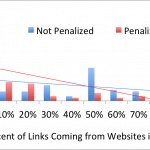
penguin penalizes more for having no relevant inbound links than lots of non-niche inbound linksI made this chart by eye-balling the numbers in a pair of charts from the MicrositeMasters study. The chart shows two things:

i) It doesn’t matter if you have a high or low percent of inbound links from websites with content that is relevant to yours, as long as you have SOME quality, niche inbound links: websites with low percentage (10%) of same-niche inbound links were penalized at the same rate as sites with high percentage (60-100%) of relevant inbound links.

ii) It matters a LOT if you have NO relevant inbound links – the red bars show that about half of websites with 0% of relevant inbound links were penalized. Once you have even 10% of your links coming from quality, relevant sites though, Penguin isn’t penalizing you for having non-niche links too.

Action Item: Make sure you have some inbound links from quality, relevant websites.

That’s not easy – and it’s part of the point of Penguin: good content creation and targeted community development around your site is harder than typing a keyword into 20 anchor texts. Countless blog posts offer advice on building a quality community (inbound links from websites with good content related to your site). Here are a few tidbits from Brownrigg’s insights on generating a community for your website.

i) Post quality articles relevant to your niche (that people will want to repost on their site).

ii) Compile some of your articles into an ebook.

iii) Publish your articles on sites like digg and submit them to article directories.

Post-Penguin Reality

Penguin seems to have a fairly narrow target – keyword-over-optimized text anchors and disproportionate inbound links from irrelevant websites: in other words, it has effectively removed shortcuts for generating website traffic. In general, however, and despite the apocalyptic rhetoric out there, the new Sheriff should leave the world with a lot of well-deserved winners – people creating genuinely good content and generating traffic with honest “white-hat” methods that ultimately benefit the 2,267,233,742 people searching for content on the World Wide Web.

Google Penguin Sheriff

Image from cognitiveseo.com/blog

With the roll out of the new Google +1 share button, chances are you will want to add this snazzy button to help optimize your website or blog. Installing the Google +1 share button is very simple.

Place this tag in your head or just before your close body tag:

<script type=”text/javascript” src=”https://apis.google.com/js/plusone.js“></script>

Place this tag where you want the +1 button to render:

<g:plusone></g:plusone>

The button should look something like this on your website.

You can go here to create a custom +1 button and/or access some very helpful Google +1 button FAQs.