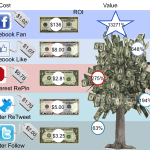
If you’re the person in charge of social media at your company, Pinterest may cause you to groan and look for excuses to opt out of maintaining yet another communication channel. Unfortunately Pinterest is increasingly looking like a medium marketers shouldn’t ignore; fortunately, it also looks like a medium that delivers significant ROI, and might […]
Meet the Stars of Search Marketing

SEO.com recently came out with a stellar infographic featuring the Stars of Search Marketing. You may or may not yet be familiar with these names but in the world of Search Engine Optimization, you should definitely know their work. This fun infographic also showcases the future of search according to these SEO experts.
Stephen Colbert to Bing, you got “hiybbprqag!”
“For the first time ever, someone’s search history has been busted for something other than porn.” – Stephen Colbert Earlier this week, Danny Sullivan from Search Engine Land, reported that Google has proof of Bing copying their search results. Bing fervently denied this accusation and instead accused Google of click fraud involving “honeypot” search results. Well apparently, the […]
iPad, iPed, iPid, iPod, iPud
Previously only one of those words was an Apple product. After January 26th, however, Apple now sells iPads along with iPods. What may be a silly name or a great name briefly caused a bit of confusion with the search engines. IPED and IPEDS are acronyms that have quite a few results in Google, Yahoo, […]
Google Website Trends in an Election Year
2008 is proving to be a fruitful year for Web 2.0 and the election. Barack Obama, the current saviour du jour, is leading the way in embracing the web and us the ‘prosumers.’ Searching Google Trends on site stats for both McCain and Obama show the Obama site seems to have that gooey factor that […]
Google Celebrates National Teacher Day
Are you a teacher or know someone that is? Google is celebrating National Teacher Day by inviting all educators to the Google Teacher Academy at Googleplex in Mountain View, California on June 25, 2008. What is the Google Teacher Academy? It is a one day FREE professional development event designed specifically to help K-12 teachers […]
Google Leap Day Logo and How Kids Create Their Own
Google is always coming up with cool logos for their homepage for holidays and special occasions. Here’s today’s for Leap Day! Also you can register your school -age children to participate in a Google Doodle Contest! It’s a competition where students from grades K-12 can play around with the Google Logo and see what they […]
Top Trends in Search in 2007 – Yahoo
Yahoo released their top search trends for 2007 yesterday and its a great break-down of how 2007 played out. The middle East, Britney Spears and new technology reined supreme in 2007 Rounding out the top news searches of 2007 was searches for cell phone footage of Saddam Hussein’s final moments. 5 of the top 10 […]
Google Doodle – 50th anniversary of Sputnik
Google routinely changes their logo to mark a point of history. Today it was the 50th anniversary of the Sputnik launch. The Sputnik ‘was the first artificial satellite to be put into geocentric orbit. Launched by the Soviet Union on October 4, 1957, it was the first satellite of the Sputnik program.’ [wikipedia]. Sputnik […]